
Peristyle translated from Greek means – an open space, surrounded by columns and roofed over. In its appearance and function it reminds us of a vestibule or a colonnaded corridor.
The Peristyle in Split is the square in front of the Cathedral of St Domnius in the Old Town of Split. Its original name was the Pavement (Pločata) of St Domnius. It consists of the peristyle of the former Diocletian's Palace.
This peristyle lay on the main cardo of the former Diocletian's Palace and, in its northern part, crossed its main decumanus. On its sides it is bordered by two rows of columns in the Corinthian style, linked to one another by arches. The sides were decorated with two sphinxes, one of which still stands in the square today, almost perfectly preserved.
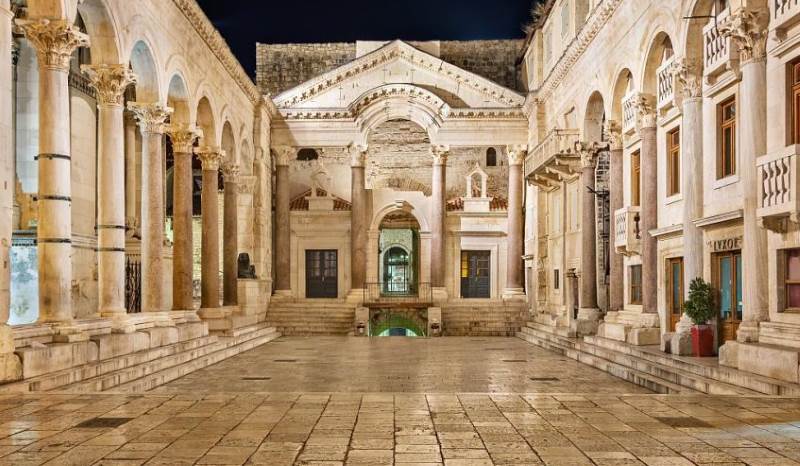 The façade of the square itself is divided into two parts: the upper one leads into the Vestibule, and the lower one, by steps, into the magnificent cellars of the palace. The part leading into the Vestibule is decorated with three statues, one of which represented Emperor Diocletian, another the god Jupiter, while the third remains unknown.
The protiron, which stood on the southern side, also had an important and functional role in the overall appearance of the Peristyle. From this part, Emperor Diocletian would address the inhabitants of the other part of the palace. It also connected – or rather separated – the northern part of the palace, for servants and the army, from the southern part, where the emperor resided with those closest to him. On its western side stood the baptistery (the Temple of Jupiter), as well as the temples of Venus and Cybele, and on its eastern side, Diocletian's mausoleum, today's cathedral.
Today the Peristyle is used as a space for all important events in the Palace, and because of its excellent acoustics it often serves as a natural stage and venue for many musical and theatrical events. It is precisely here that the most famous traditional performance of Verdi's Aida takes place during the Split Summer Festival.
The Peristyle is the main square of Diocletian's Palace, which we can also call the 'heart of the palace'. It had this role right from the construction of the palace, and interestingly it is still used for similar purposes today. It lies at the crossing of the cardo and decumanus of the former Diocletian's Palace. The Peristyle is framed on three sides by 24 granite columns. On its sides it is bordered by two rows of columns in the Corinthian style, linked to one another by arches.
Its sides are decorated with sphinxes, one of which still stands in the square today, almost perfectly preserved. Unfortunately, the others have been damaged and lost over time.
In architectural terms, the importance of the Peristyle is noted by H. W. Janson in his famous “History of Art”. “A few isolated examples of this kind of arcade can be found even earlier, but only now, on the threshold of Christianity's victory, did the union of arch and column become fully legitimate.”
Among the buildings surrounding the Peristyle we can particularly mention the churches: the Church of St Roch, Our Lady of the Girdle, and St Barbara, which has been demolished. Today these churches no longer serve their original purpose. After a new city square with a new town hall was built at the end of the 13th and beginning of the 14th century, the Peristyle became a religious centre.
We have already written this before, but let us mention it once again. Today the space of the square itself is used as a venue for events in the palace and, because of its excellent acoustics, it often serves as a natural stage and venue for many musical and theatrical spectacles.
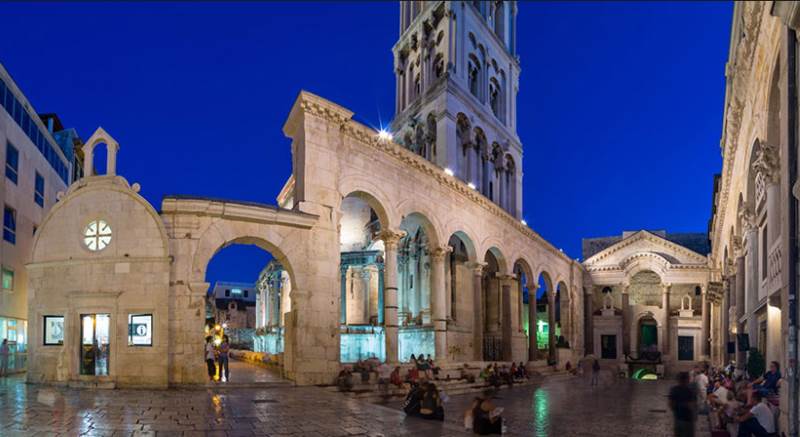 Interesting details that once again bring the Peristyle into the story. In the time of Marko Marulić, the city was marked by a cathedral named after the Salona martyr St Domnius. In one of his texts, Marulić describes the cathedral and the Peristyle in front of it. Interestingly, this text is considered the first guide to Split. The original ancient structure described by Marulić was erected at the beginning of the 4th century as the mausoleum of Emperor Diocletian. His figure, together with that of his wife Prisca, can still be seen today on the frieze beneath the dome. In his will of 1521, Marulić bequeathed funds for the repair of the bell tower of the Cathedral of St Domnius and the Church of St Roch on the Peristyle. Many skilled sculptors and stonemasons worked on the repair of the bell tower, which was built up until the 17th century.
The bell tower was radically renovated in 1908, during which it unfortunately lost most of its originally sculptural decoration.
The capital bearing the coat of arms of the Marulić family, which stood on the bell tower, was transferred to the City Museum. Luxury modern apartment on beachSplitCapacity: 2-4 · To the sea: 20 mfrom 8,50 € per person / nightView offer
 Split Green Eden & Blue HorizonSplitCapacity: 2-6 · To the sea: 200 mView offer
 Apartmani BlaževićSplitCapacity: 2-8 · To the sea: 10 mfrom 8 € per person / nightView offer
 Lobster ApartmentsSplitCapacity: 3-23 · To the sea: 400 mfrom 20 € per person / nightView offer
 Apartman PujankeSplitCapacity: 2-5 · To the sea: 1 kmView offer
 Green paradise villaSplitCapacity: 4-11 · To the sea: 1 kmView offer

This peristyle lay on the main cardo of the former Diocletian's Palace and, in its northern part, crossed its main decumanus. On its sides it is bordered by two rows of columns in the Corinthian style, linked to one another by arches. The sides were decorated with two sphinxes, one of which still stands in the square today, almost perfectly preserved.
The façade of the square itself is divided into two parts: the upper one leads into the Vestibule, and the lower one, by steps, into the magnificent cellars of the palace. The part leading into the Vestibule is decorated with three statues, one of which represented Emperor Diocletian, another the god Jupiter, while the third remains unknown.The protiron, which stood on the southern side, also had an important and functional role in the overall appearance of the Peristyle. From this part, Emperor Diocletian would address the inhabitants of the other part of the palace. It also connected – or rather separated – the northern part of the palace, for servants and the army, from the southern part, where the emperor resided with those closest to him. On its western side stood the baptistery (the Temple of Jupiter), as well as the temples of Venus and Cybele, and on its eastern side, Diocletian's mausoleum, today's cathedral.
Visit and take a detailed look at the Peristyle
Today the Peristyle is used as a space for all important events in the Palace, and because of its excellent acoustics it often serves as a natural stage and venue for many musical and theatrical events. It is precisely here that the most famous traditional performance of Verdi's Aida takes place during the Split Summer Festival.
The Peristyle is the main square of Diocletian's Palace, which we can also call the 'heart of the palace'. It had this role right from the construction of the palace, and interestingly it is still used for similar purposes today. It lies at the crossing of the cardo and decumanus of the former Diocletian's Palace. The Peristyle is framed on three sides by 24 granite columns. On its sides it is bordered by two rows of columns in the Corinthian style, linked to one another by arches.
Its sides are decorated with sphinxes, one of which still stands in the square today, almost perfectly preserved. Unfortunately, the others have been damaged and lost over time.
In architectural terms, the importance of the Peristyle is noted by H. W. Janson in his famous “History of Art”. “A few isolated examples of this kind of arcade can be found even earlier, but only now, on the threshold of Christianity's victory, did the union of arch and column become fully legitimate.”
Buildings adjoining the Peristyle in Split
Among the buildings surrounding the Peristyle we can particularly mention the churches: the Church of St Roch, Our Lady of the Girdle, and St Barbara, which has been demolished. Today these churches no longer serve their original purpose. After a new city square with a new town hall was built at the end of the 13th and beginning of the 14th century, the Peristyle became a religious centre.
We have already written this before, but let us mention it once again. Today the space of the square itself is used as a venue for events in the palace and, because of its excellent acoustics, it often serves as a natural stage and venue for many musical and theatrical spectacles.
The Cathedral and the Peristyle of Diocletian's Palace
Interesting details that once again bring the Peristyle into the story. In the time of Marko Marulić, the city was marked by a cathedral named after the Salona martyr St Domnius. In one of his texts, Marulić describes the cathedral and the Peristyle in front of it. Interestingly, this text is considered the first guide to Split. The original ancient structure described by Marulić was erected at the beginning of the 4th century as the mausoleum of Emperor Diocletian. His figure, together with that of his wife Prisca, can still be seen today on the frieze beneath the dome. In his will of 1521, Marulić bequeathed funds for the repair of the bell tower of the Cathedral of St Domnius and the Church of St Roch on the Peristyle. Many skilled sculptors and stonemasons worked on the repair of the bell tower, which was built up until the 17th century.The bell tower was radically renovated in 1908, during which it unfortunately lost most of its originally sculptural decoration.
The capital bearing the coat of arms of the Marulić family, which stood on the bell tower, was transferred to the City Museum.
Private accommodation in Split – directly from the owners
All accommodation in Split →Luxury modern apartment on beachSplitCapacity: 2-4 · To the sea: 20 mfrom 8,50 € per person / nightView offerSplit Green Eden & Blue HorizonSplitCapacity: 2-6 · To the sea: 200 mView offerApartmani BlaževićSplitCapacity: 2-8 · To the sea: 10 mfrom 8 € per person / nightView offerLobster ApartmentsSplitCapacity: 3-23 · To the sea: 400 mfrom 20 € per person / nightView offerApartman PujankeSplitCapacity: 2-5 · To the sea: 1 kmView offerGreen paradise villaSplitCapacity: 4-11 · To the sea: 1 kmView offerFollow us on Facebook for more articles about Croatia. Share this article using the buttons on the right. Thank you!

Upgrade this article
Bio si na ovom mjestu? Podijeli s nama svoja iskustva ili fotografije.
Napiši svoju verziju članka. Nagrađujemo vlasnike apartmana.