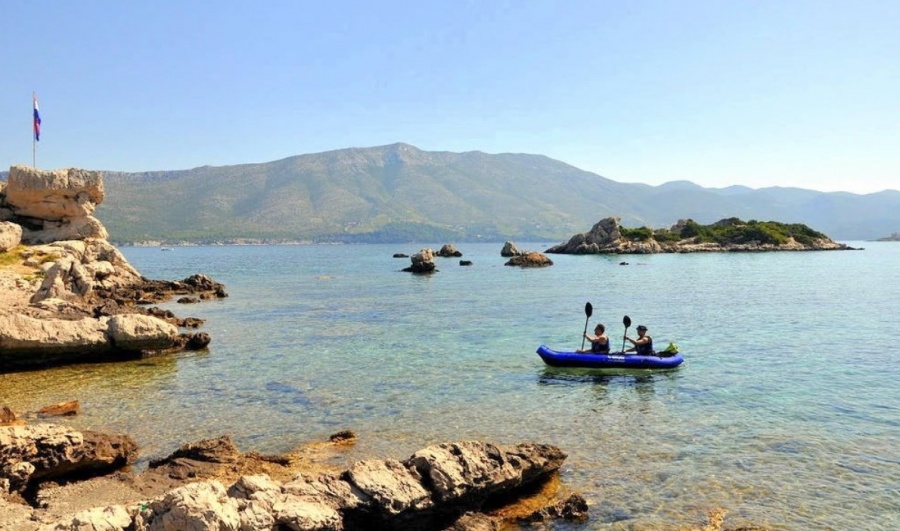

The Forteca-Sv. Vlaho fortress rises on the hill of the same name southwest of the historic core of the town of Korčula, in Dubrovnik-Neretva County. The town can be seen from the hill, and the site links several different epochs.
On the rise stand the so-called English Tower, a Venetian fortress of the bastion type and the remains of the medieval church of Our Lady of the Gardens. The church stood on the site of the tower from the 13th century, and was also called St. Blaise (Sv. Vlaho), which has survived as a toponym. The fortress was built in barely a month, during October and November 1617, because of the danger from the Spanish fleet. The walls form an irregular polygon, entirely of rubble stone in dry-stone, and the corners are reinforced with triangular projections. Under British administration, in 1813, a round tower tapering toward the top was built in the middle of the fortress, of the Martello tower type that had been built throughout the British Empire since the end of the 18th century. The British call it Fort Wellington. The period of origin spans the 13th to the 19th century.
The fortress is a protected cultural good, entered in the Register of Cultural Goods of the Republic of Croatia under the code Z-6621.
Data: Register of Cultural Goods of the Republic of Croatia (Ministry of Culture and Media), Open Licence. Apartmani Marica PecotićKorčulaCapacity: 2-12 · To the sea: 30 mView offer
 Apartmani MarijanaKorčulaCapacity: 4-16 · To the sea: 200 mView offer
 Apartments Cannela OasisKorčulaCapacity: 2-5 · To the sea: 25 mfrom 15 € per person / nightView offer
 Apartmani AnaKorčulaCapacity: 2-10 · To the sea: 10 mView offer
 Apartmani Plava kuća KorčulaKorčulaCapacity: 2 · To the sea: 700 mView offer
 Apartments PetarKorčulaCapacity: 4-12 · To the sea: 10 mfrom 20 € per person / nightView offer
On the rise stand the so-called English Tower, a Venetian fortress of the bastion type and the remains of the medieval church of Our Lady of the Gardens. The church stood on the site of the tower from the 13th century, and was also called St. Blaise (Sv. Vlaho), which has survived as a toponym. The fortress was built in barely a month, during October and November 1617, because of the danger from the Spanish fleet. The walls form an irregular polygon, entirely of rubble stone in dry-stone, and the corners are reinforced with triangular projections. Under British administration, in 1813, a round tower tapering toward the top was built in the middle of the fortress, of the Martello tower type that had been built throughout the British Empire since the end of the 18th century. The British call it Fort Wellington. The period of origin spans the 13th to the 19th century.
The fortress is a protected cultural good, entered in the Register of Cultural Goods of the Republic of Croatia under the code Z-6621.
Data: Register of Cultural Goods of the Republic of Croatia (Ministry of Culture and Media), Open Licence.
Private accommodation in Korčula – directly from the owners
All accommodation in Korčula →Apartmani Marica PecotićKorčulaCapacity: 2-12 · To the sea: 30 mView offerApartmani MarijanaKorčulaCapacity: 4-16 · To the sea: 200 mView offerApartments Cannela OasisKorčulaCapacity: 2-5 · To the sea: 25 mfrom 15 € per person / nightView offerApartmani AnaKorčulaCapacity: 2-10 · To the sea: 10 mView offerApartmani Plava kuća KorčulaKorčulaCapacity: 2 · To the sea: 700 mView offerApartments PetarKorčulaCapacity: 4-12 · To the sea: 10 mfrom 20 € per person / nightView offerFollow us on Facebook for more articles about Croatia. Share this article using the buttons on the right. Thank you!

Accommodation nearby
Directly from the owners, no commission
Upgrade this article
Bio si na ovom mjestu? Podijeli s nama svoja iskustva ili fotografije.
Napiši svoju verziju članka. Nagrađujemo vlasnike apartmana.